What Is Voltage Source Converter . When the voltage source is connected with the resistance in series and it has to be converted into the current source than the resistance is connected in parallel with the current source as shown in the above figure. Voltage source inverter abbreviated as vsi is a type of inverter circuits that converts a dc input voltage into its ac equivalent at the output. Pyramid PS8KX Tools and Meters Power Supply Power from www.pyleaudio.com A voltage source inverter or vsi is a device that converts unidirectional voltage waveform into a bidirectional voltage waveform, in other words, it is a converter that converts its voltage from dc form to ac form. Vsc converters used for power transmission (or voltage support combined with an energy storage source) permit continuous and independent control of real and reactive power. The dc link is parallel capacitors, which regulate the dc bus voltage ripple and store energy for the system.
Voltage Gain Symbol. Gain or amplification for the three differnt types of amplifiers can be described using the appropriate formula: The ratio will be 1000/10 = 100, and the voltage gain will be 20×log 100 = 40 db.
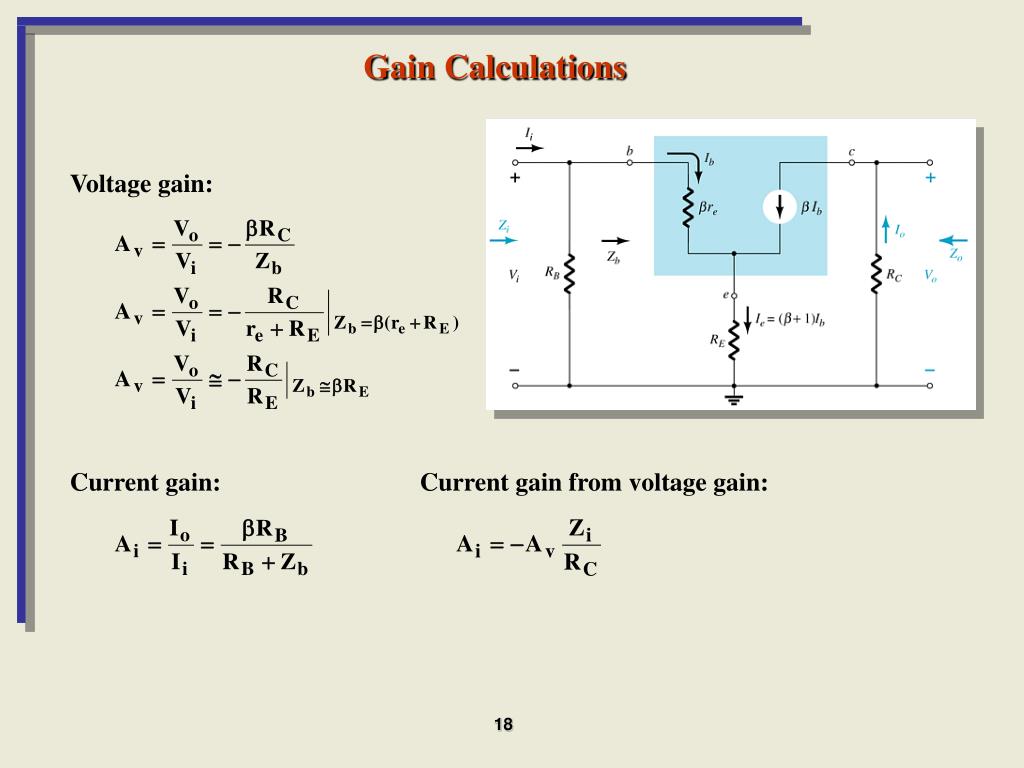
PPT Chapter 5 BJT AC Analysis PowerPoint Presentation from www.slideserve.com
Gain or amplification for the three differnt types of amplifiers can be described using the appropriate formula: Overall gain of the system is 3 × 5 = 15. Active 5 years, 6 months ago.
Suppose One Amplifier Has Gain Of 3 And Another Has 5 And These Two Amplifiers Are Connected In Cascaded Manner.
• input resistance :rin = ∞ • output resistance: In this configuration, an op amp produces an output potential (relative to circuit ground) that is typically 100,000 times larger than the potential difference between its input terminals. This component has no default artwork associated with it.
Vb Vs Vbias Vout Vdd Vss Id Isup Rs Signal Source
Therefore the higher the value of gm the greater the amplification. Voltage gain av = amplitude of output voltage ÷ amplitude of input voltage. Viewed 35k times 6 4 $\begingroup$ in sears and zemansky's university physics book and in many other books in english they define the following sign conventions (used for kirchhoff loop rule for example):
V 2 Is The Voltage At The Inverting Terminal.
It is a logarithmic unit expressed in db and is commonly used to represent the ratio of input to output in amplifier, audio circuits or loudspeaker systems. In decibel scale this overall gain is 10 log15 = 11.76 db which is nothing but 4.77 + 6.99. Ic/ie is the current gain, alpha ( a ).
Ask Question Asked 8 Years, 3 Months Ago.
An opamp essentially consists of two input terminal and one output terminal. Voltage gain is nothing but the ratio of output voltage and input voltage. This is the symbol of an opamp.
Voltage Gain Can Be Achieved By Using Amplifiers.
The ratio will be 1000/10 = 100, and the voltage gain will be 20×log 100 = 40 db. Voltage gain is defined as the ratio of the output voltage to the input voltage in db. The voltage gain of a ce amplifier varies with signal frequency.


Comments
Post a Comment